Open your breaker panel and you may notice some breakers look different from the rest. They might have a small TEST button, a colored label, or the letters AFCI printed on the handle. That is an arc-fault circuit interrupter breaker, and it is one of the most important fire-safety devices in your Kyle home. Yet most homeowners have no idea what it does or why it occasionally trips for no apparent reason.
This guide explains arc detector breakers in plain language: what arc faults are, how AFCI breakers stop them, where they are required, and what to do when one keeps tripping.
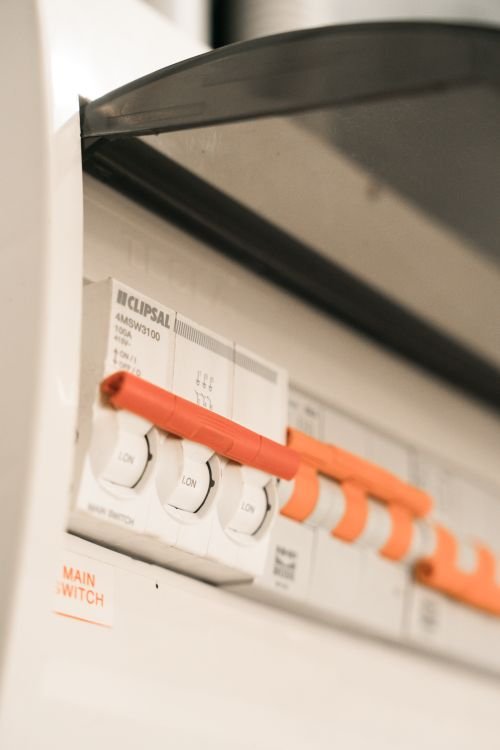
What is an arc fault?
An arc fault is an unintended electrical arc, essentially a tiny lightning bolt jumping across a gap in your wiring. It happens when wires are damaged, loose, or pinched: a nail driven through a cable inside a wall, a cord chewed by a rodent in the attic, a loose terminal screw in an outlet, or insulation cracked by years of Central Texas heat in the attic. The arc generates extreme heat, often thousands of degrees, which can ignite wood framing, insulation, or dust long before a standard breaker ever notices anything wrong.
Here is the scary part: an arcing fault can draw less current than the breaker’s rating, so an ordinary breaker sees nothing abnormal and never trips. The arc just keeps sparking inside your wall. Electrical arcs are a leading cause of home electrical fires in the United States, which is exactly why AFCI protection was developed.
How an AFCI breaker works
An AFCI breaker contains a tiny computer that constantly listens to the electrical waveform on its circuit. Normal electricity has a smooth, predictable signature. An arc fault creates a chaotic, crackling signature full of high-frequency noise. When the breaker’s electronics recognize that dangerous pattern, it trips in a fraction of a second, cutting power before the arc can start a fire.
Think of it this way: a standard breaker is a bouncer that only reacts when too many people rush the door at once (an overload or short circuit). An AFCI breaker is a bouncer that also recognizes the sound of trouble starting and shuts the party down early.
AFCI vs. GFCI: what is the difference?
Homeowners often confuse the two, but they protect against completely different hazards:
- AFCI (arc-fault circuit interrupter) prevents fires by detecting dangerous arcing in wiring. Required mainly in living areas and bedrooms.
- GFCI (ground-fault circuit interrupter) prevents electrocution by detecting current leaking to ground, such as through a person. Required in bathrooms, kitchens, garages, outdoors, and other wet locations.
Many modern breakers combine both protections in one device, called a dual-function AFCI/GFCI breaker. If your panel was upgraded in the last decade, you may already have them.
Where are AFCI breakers required?
The National Electrical Code has expanded AFCI requirements over the years. Current code generally requires AFCI protection for most 15- and 20-amp branch circuits serving living areas: bedrooms, living rooms, family rooms, dining rooms, dens, hallways, closets, and similar spaces. Kitchens, bathrooms, and garages lean more on GFCI protection, though dual-function breakers increasingly cover both.
If your Kyle home was built before AFCI requirements took effect, your bedrooms are likely protected only by standard breakers. Upgrading those circuits to AFCI protection is one of the highest-value safety improvements you can make, especially in older homes where wiring insulation has had decades to deteriorate.
Why does my AFCI breaker keep tripping?
Nuisance tripping is the most common complaint about AFCI breakers, and it has several possible causes. Sometimes the breaker is doing its job and has found a genuine arc fault, like a damaged cord or a loose outlet connection. Other times, certain devices confuse the electronics: older treadmills, some vacuum cleaners with brushed motors, and cheap LED drivers can produce waveforms that look like arcing.
- Unplug everything on the circuit, reset the breaker, then plug items back in one at a time to identify the culprit.
- Inspect cords and plugs for damage, chew marks, or pinching behind furniture.
- If the breaker trips with nothing plugged in, the fault is in the fixed wiring, and you need an electrician.
- Never replace an AFCI breaker with a standard breaker to stop the tripping. That removes fire protection your home was designed to have.
Safety note: test them regularly
AFCI breakers have a TEST button for a reason. Press it every few months: the breaker should trip immediately. Then switch it fully off and back on to reset. If the TEST button does nothing, the breaker’s electronics may have failed, and it is providing no arc-fault protection at all. Replace it promptly. And remember, working inside a breaker panel exposes you to live parts that can kill. Leave breaker replacement to a qualified electrician.
Arc-fault breakers are silent guardians. You may never notice them working, but they stand between a damaged wire and a house fire every single day. If your panel still uses standard breakers on bedroom and living-area circuits, or if an AFCI breaker keeps tripping and you cannot find why, have it checked. Learn more about our circuit breaker repair services in Kyle, TX. Call KyleElec at (512) 555-0199 or email kyleelecc@gmail.com for an evaluation of your panel’s protection.
Leave a Reply